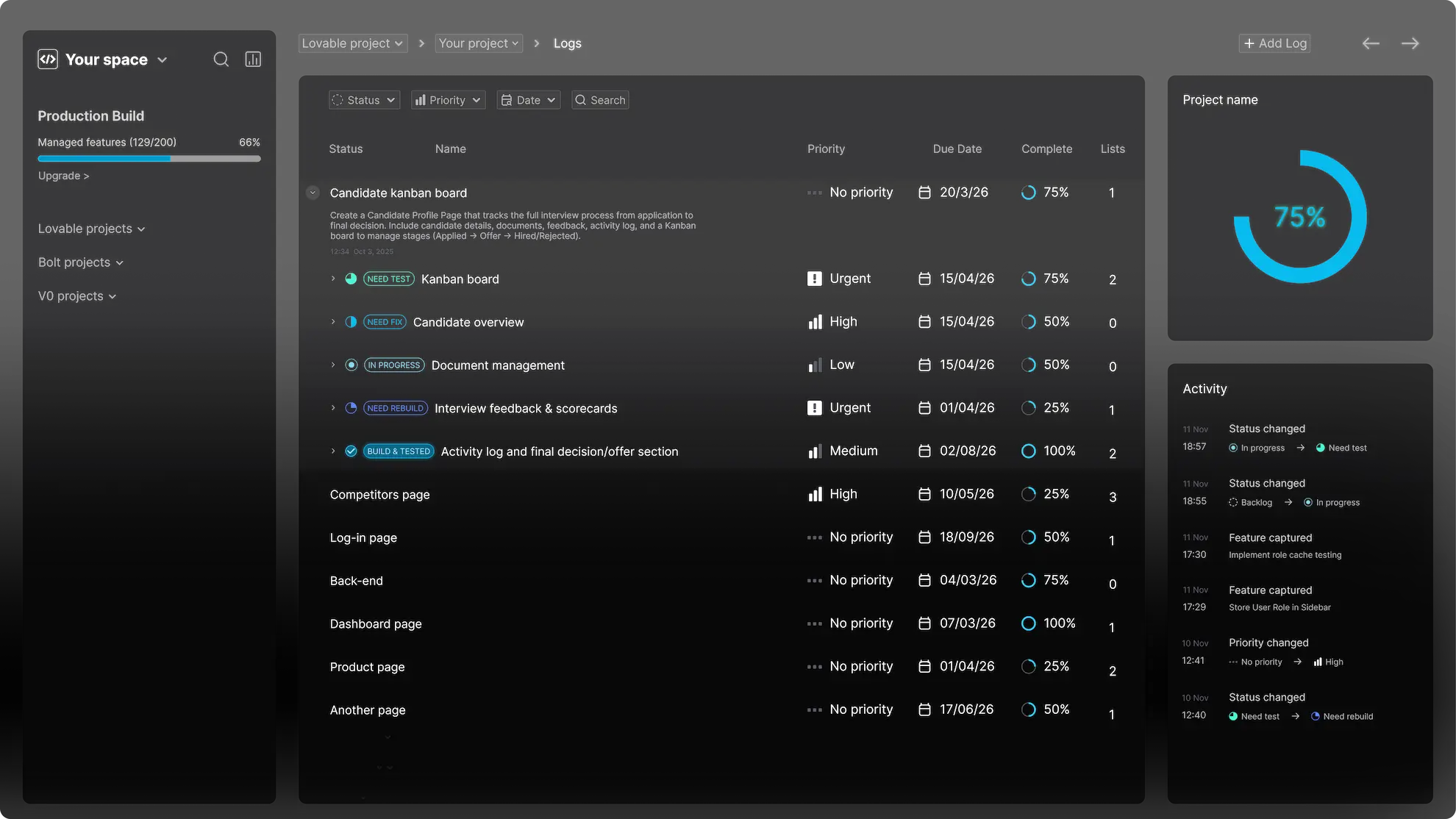
Built from speed. Broken by chaos. Fixed with structure.
When I first started building with AI coding tools, it felt unreal.
Ideas turned into working features in minutes.
What used to require engineers, planning, and long backlogs suddenly happened inside a chat window.
For the first time, building software felt creative instead of slow.
I could test ideas instantly.
Ship experiments daily.
Explore products that would have taken weeks before.
It felt like the future.
A printing press moment for software development.
But after the first few days, something started to feel off.
Speed wasn’t the problem. Broken by chaos. Losing control was.
The more I built, the less I understood what I had actually created.
I couldn’t answer basic questions anymore:
• What features already exist?
• Which ones are stable — and which are just experiments?
• What still needs testing?
• What broke when I changed something yesterday?
Ideas lived in conversations.
Decisions disappeared in scrollback.
Versions blurred together.
I rebuilt features I had already built.
I burned credits on outputs I couldn’t reuse.
I hesitated to ship — not because things weren’t ready, but because I didn’t trust them.
Every day started to feel like guesswork.
The real issue: We weren’t building products. We were generating fragments.
AI made creating code easy.
But it removed everything that turns code into software:
• Structure
• Ownership
• Contuinity
• Visibility
• Accountability
Traditional teams solve this with process, tooling, and discipline.
Vibe coders had none of it.
The result wasn’t bad code.
It was unmanageable progress.
And the faster I moved, the worse it got.
I looked for a solution. It didn’t exist.
I tried notes.
Spreadsheets.
Task tools.
Docs.
Nothing worked — because none of them were built for AI-driven development.
They live outside the build process.
They don’t understand prompts, intent, or iteration.
They can’t connect what you asked the AI to do with what actually shipped.
The core problem stayed untouched.
That’s when it clicked.
AI doesn’t need better prompts.
It needs a system around it.
A layer that sits above AI coding tools.
That remembers what was built.
Tracks intent.
Creates clarity.
And turns fast experimentation into something you can actually ship.
That missing layer became Codelogs.
Why I builded Codelogs
Codelogs gives vibe coders what professional software teams have always relied on — without slowing them down.
Not another builder.
Not another prompt playground.
But a system that turns raw prompting into a guided, trackable, repeatable development process.
Our mission is simple: To help the next generation of builders turn AI-powered speed into real, reliable software.
Codelogs exists so founders can stop guessing, stop rebuilding, and stop losing control — and finally ship products that last.
Because the future of software isn’t just faster.
It’s structured.
We bring structure into chaos.
Clarity into speed.
And trust back into the build process.
So you always know:
• what exists
• what's stable
• what's next
• and what you’re actually shipping
Because building with AI shouldn’t feel fragile.
And shipping software shouldn’t feel like a gamble.
Vibe coding unlocked speed. We fix everything it broke.